
Quick answer: The "Sunday scaries" are the wave of anxiety or dread that builds on a Sunday evening as the working week looms. They're a form of anticipatory anxiety — your nervous system bracing for pressure that hasn't arrived yet. They're extremely common, they aren't a personal flaw, and they ease when you give your body safety cues and change how Sunday itself feels.
It usually creeps in somewhere around late afternoon. The light shifts, Sunday stops feeling like a day off and starts feeling like a waiting room for Monday, and a familiar tightness arrives — a low dread, a busy head, maybe a knot in your stomach. If your weekend quietly sours every Sunday evening, you're experiencing what's fondly known as the "Sunday scaries." You're in very good company, and — reassuringly — it's a pattern that tends to loosen quickly with the right approach.
What the Sunday scaries actually are
They're an everyday form of anticipatory anxiety — anxiety about something that hasn't happened yet. Your body has a "go" gear (the sympathetic nervous system) that handles pressure, and a "rest" gear (the parasympathetic system) for recovery. On Sunday evening, your mind starts previewing Monday — the inbox, the meeting, the workload — and your nervous system reacts to that imagined week as if it were happening now. Cue the racing thoughts and the restless stomach.
In other words, it isn't irrational and it isn't weakness. It's your threat-detection system doing its job a little too enthusiastically, on a day when there's nothing to actually respond to yet. (If your evenings struggle more generally, this is the close cousin of not being able to switch off after work.)
Why Sunday night specifically
A few things stack up at exactly this time:
- The contrast effect. After two days of ease, your brain notices the "cliff edge" back into demand — and the steeper the contrast between your weekend and your week, the louder the alarm.
- Unstructured time. Weekends remove the structure that keeps your mind occupied. Quiet, open hours give rumination room to spread.
- The countdown. As the evening shrinks, so does the sense of freedom — and attention narrows onto what's coming.
- A raised baseline. If your job keeps you in "go" mode all week, your stress response may already be running high. Sunday simply removes the distractions that were masking it, so you finally feel the activation that was there all along.
Why "just relax" (or "it's irrational") doesn't work
Telling yourself the feeling is irrational usually just adds a layer of frustration on top of the dread. The Sunday scaries aren't a logic problem — you can't reason a nervous system out of bracing. And "just relax" is about as effective as telling a smoke alarm to be quiet. What actually helps is giving your body the right cues, in the right order, so it gets the message that it's safe to stand down.
How to ease Sunday night anxiety
None of these are dramatic. They work because they speak your nervous system's language — safety, structure and repetition — rather than relying on willpower.
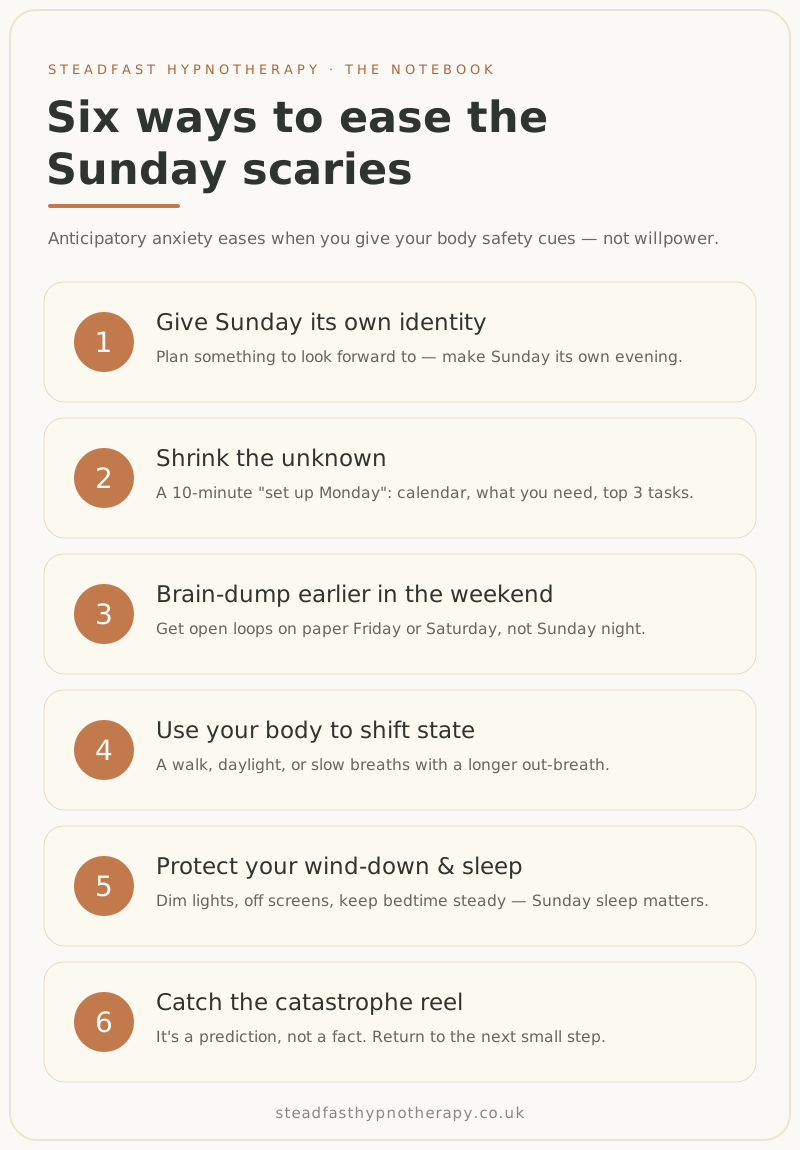
- Give Sunday evening its own identity. Plan something you genuinely look forward to on a Sunday night, so the day is its own thing rather than "the bit before Monday." Research on recovery from work suggests deliberately enjoyable, absorbing activities help you mentally detach.
- Shrink the unknown. Anticipatory anxiety feeds on uncertainty. A ten-minute "set up Monday" — glance at the calendar, lay out what you need, name your top three tasks — turns a vague, looming week into a few concrete, manageable items.
- Do it on Friday or Saturday, not Sunday night. Getting your open loops out of your head and onto paper earlier in the weekend tells your brain it can stop rehearsing them — so they're less likely to ambush you on Sunday.
- Use your body to change your state. A Sunday afternoon walk, some daylight, or a few slow breaths with the out-breath longer than the in-breath gently nudge you toward "rest" mode. State follows the body faster than it follows logic.
- Protect your wind-down — and your Sunday sleep. Sunday night is the most commonly disrupted night of the week. Dim the lights, step away from screens, and keep your bedtime consistent so Monday doesn't start on empty.
- Catch the catastrophe reel. Notice the "the whole week is going to be awful" story for what it is — a prediction, not a fact — and gently bring your attention back to the single next thing you actually need to do.
When it's more than the Sunday scaries
An uneasy Sunday evening here and there is part of being human. But if the dread shows up most weekends, starts eating into your Saturday, regularly wrecks your sleep, or sits as a low background hum that never fully lifts, that's worth taking seriously — and worth mentioning to your GP. Sometimes it's a sign your baseline has crept into "go" mode and stayed there; sometimes it's useful information about the role or situation itself.
How hypnotherapy helps
Solution-focused hypnotherapy works gently with that bracing response. Rather than digging back through everything that's ever gone wrong, we spend our time building the calm, focused state you want more of — helping move you out of survival mode and into a steadier place to meet the week from. Many people find their Sunday evenings start to feel lighter over a handful of sessions. The work is forward-looking, practical, and paced entirely to you.
If reading this felt a little too familiar, that's usually a good sign you're exactly the kind of person this work helps.